Free startup ideas and frameworks to help you win on the internet. The weekly email written by Greg Isenberg that gets 100,000+ people's creative juices flowing.
95% of internet communities are dead, 5% are beautiful businesses
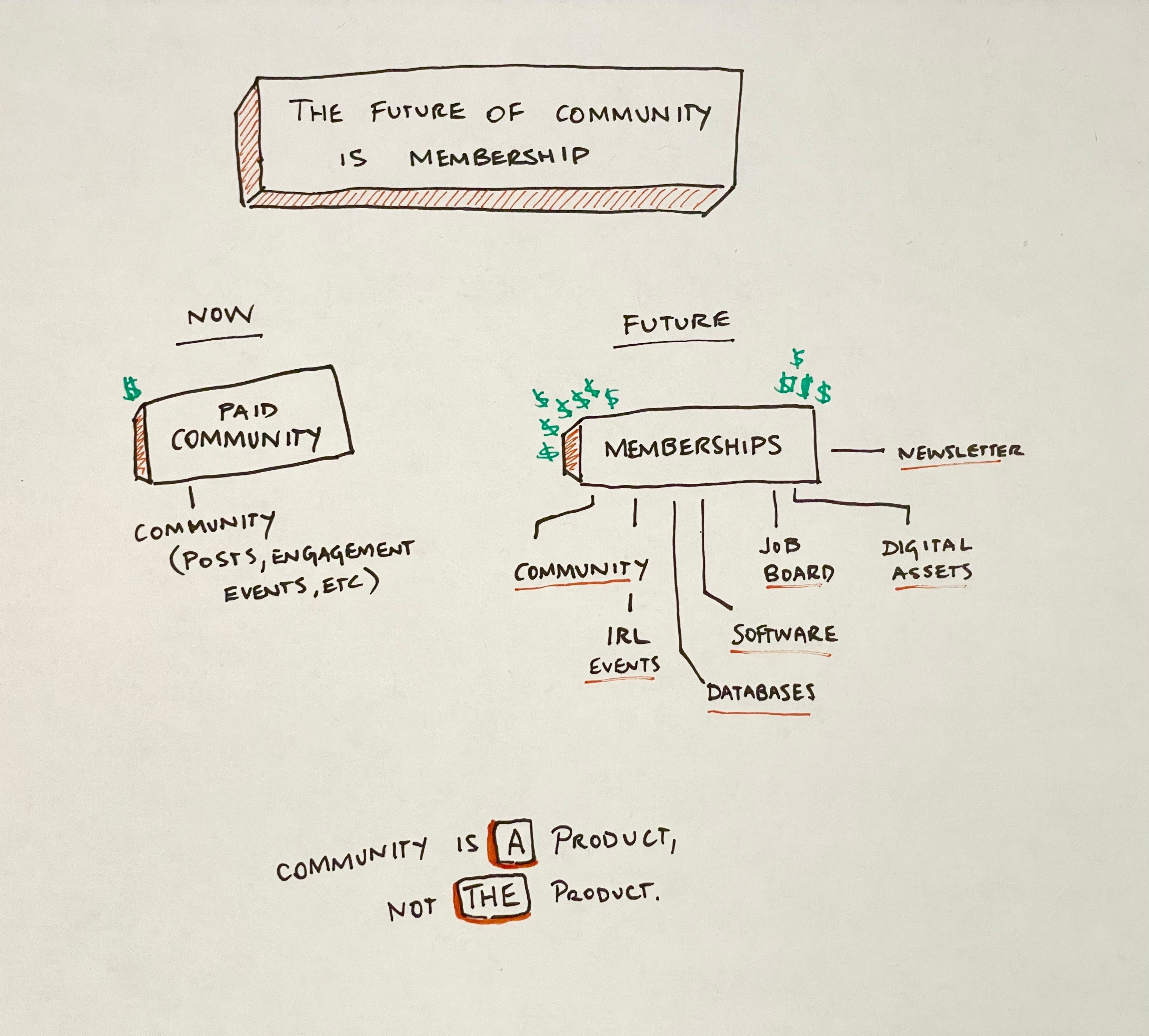
Before we begin, I just posted a podcast with Dickie Bush, Nicolas Cole on how we'd make $10M in 2024. Watch it on YouTube (it was recorded in their cool Miami studio) or listen on Apple Podcasts and Spotify. Enjoy! The hidden goldmine of 2024 – why internet memberships are outshining communities90%+ of internet communities are zombies. People have invested millions in them and they lost their heartbeat. But there’s a small group of them that are doing 7 to 9 figures a year of revenue and are thriving. It gives us a glimpse into one of the biggest business opportunities of 2024 that no one is talking about: internet memberships. Today, I'm unpacking why memberships are the new kings of the internet community space. Pandemic pivot – from physical to digital Remember when COVID hit, and we all flocked to online communities? We couldn't hang out at our usual spots, so the digital world became our go-to. We saw Facebook Groups explode past 1+ billion active users. Discord’s valuation soared to $15 billion. Clubhouse raised money at $4B. And a gold rush ensued. Now, most of these communities were free. But people began experimenting with new models to start monetizing the thousands of members that entrepreneurs amassed. Monetizing communities – the trial and error A popular way to monetize was just charging for access to a sliver of the community. Think of a group for stock market ideas, or a group of female founders but you had to pay a monthly fee. "Pay us a monthly fee and you’ll get access to a community." Every Tom, Dick and Harry were selling paid communities. Money was flowing. Until it wasn't. Retention was the major issue. People just weren’t coming back and churning. They would rather spend their money on IRL experiences like going to Coachella or eating croissants in France with friends. With the world opening up, many paid communities were closing down. Turns out selling a velvet rope wasn’t the right product for monetizing most of these communities. The membership evolution – come for the access, stay for the membership But hold on, something shifted recently. A handful of these communities didn’t just survive; they evolved into full-fledged businesses. And they're not just communities anymore – they are memberships. Breaking down the differences between a community and a membership
What’s the difference? Let’s break it down. A paid community is paying for access to:
The team is usually a community manager or a founder + community manager. These businesses are often solopreneur businesses. A membership includes things like:
WeightWatchers is the original membership company. There's a digital component, physical component, community component and everything is gamified with points (a common feature of membership businesses). They even have a GLP-1 drug they sell nowadays. The team for memberships is usually larger, more diverse skill set (engineers, product people, marketers, community managers etc) versus just a community team or a founder for a paid community. Why memberships triumph – the secret sauce Successful memberships have two things in common:
Let’s put this into perspective with two examples 2 examples of memberships: Keto Membership Example:
Pickleball Membership Example:
The winning formula – identity and transformation What makes these memberships stand out? Two key ingredients:
Investors are looking to capitalize on the new gold rush
It's probably the reason why Alex Hormozi made the biggest investment of his career last week into Skool, the community software that's really a membership software. It's the platform I've been using for my own membership community empire (private Q&As with me, hours of content, monthly startup idea paid newsletter based on trends etc..). I wanted to dogfood my own thesis on membership so I built my own and it's working. To summarize – 2024 will be the year of the membershipsThe mindset shift of the community is a product, not the product is a powerful one. Come for the community, stay for the membership. Forward this to a friend who might enjoy. It's free to forward. If you aren't subscribed to this newsletter, subscribe here. Next up, bookmarks I saved this week worth reading P.S: our agency LCA is the leader in building products for memberships to drive revenue and community love. We've even worked with WeightWatchers. If you have a 150k+ budget, fill out a form on our website here to learn more.
That’s a wrap! I hope you enjoyed this week’s post. Don't forget to listen to the podcast I did with Dickie Bush, Nicolas Cole on how we'd make $10M in 2024. Watch it on YouTube (it was recorded in their cool Miami studio) or listen on Apple Podcasts and Spotify. And tag me on X if you enjoyed the episode. I read every mention. Oh, and I found out that Skool has a 14-free trial. Enjoy it here if you're looking for a community/membership platform I enjoy using. Thank you for reading. Hope you found it valuable. Forward to a friend if you did. Be well, |

Greg's Letter
Free startup ideas and frameworks to help you win on the internet. The weekly email written by Greg Isenberg that gets 100,000+ people's creative juices flowing.
Before we begin, a little announcement: Offline Mode is back! A lot of people I talk to are drowning in AI news and tools but have no clear plan for what to actually build next (and where AI fits). That's why my team runs Offline Mode a 2 day event at a private estate, phones down, working on your business and implementing AI. We did the first one in January and founders are still texting wins 8 months later. One 3x'd their revenue!! So my team is running it back in Nashville as the leaves...
Today's Greg Letter is brought to you by Brex and I run my whole portfolio of startups on it. The best founders spend their time building PMF and value (not on expense reports). Brex gives you high-limit cards, banking, and sweet AI that handles the back-office busywork for you, so your team stays focused on what actually moves the company forward. It's why Vercel, OpenAI, and Anthropic already run on it. I like it a lot and they couldn't be more startup friendly. Get your Brex on here. In...

Today's Greg Letter is brought to you by Genspark I've been using Genspark Claw, a more secure, in the cloud version of OpenClaw lately and been building some AI agent startup ideas. On my latest pod on Spotify/Apple I discuss more about tiny AI agent businesses ideas I love and how to implement it. Happy building. This is what's keeping me up at night. My notes on the agent economy. Every franchise system in America (30,000+) needs an agent layer and none of them have one. One founder per...